
Saline County Wanted List
Start with the sheriff itself. The Saline County Sheriff's Office directs visitors from its official site to the sheriff's Facebook page, home of the Most Wanted feature. Social feeds have limits. They can demand a login, bury older posts, or reshuffle without warning. Want something steadier? The Salina Post Most Wanted archive gathers dated articles credited to the sheriff. Keep in mind what it is, though. It is a newspaper archive of names, booking photos, and charges, not the county's warrant database.
Every article carries a date, and that date matters. The August 2026 edition listed nineteen people. Each had sheriff-attributed photos, names, and requested charges. Other months in the series ran roughly nineteen to twenty-two entries, with occasional gaps in the sequence. The sheriff curates this roster for public attention. It is not a full export of every active warrant. A name appearing there does not mean the person sits in the Saline County Jail right now. An older snapshot can linger online long after an arrest, a court filing, or another change has made it stale. For current status, trust the sheriff's live warrant search and direct confirmation over any saved news story.
Saline Wanted Listing Fields
The Salina Post series keeps things lean. A typical entry offers a photo, a name, and the requested charges. That is all. Read only the fields the source prints, and do not guess at an address, a warrant type, a bond amount, or a danger level the article never mentions.
| Field | What it means |
|---|---|
| Photograph | An image credited by the publisher to the Saline County Sheriff's Office, not a live custody indicator. |
| Name | The identity printed in that dated list. Confirm spelling and identity through an official channel. |
| Requested charges | The charges associated with the request for information. They are not findings of guilt. |
| Article date | The date of the monthly snapshot, which helps identify how current the entry may be. |
There is no fixed publishing day, so do not read anything into the calendar. A missing month or a missing name proves nothing about whether a warrant exists. And an old photo, on its own, is never enough to identify anyone.
Use Saline Fugitives Safely
Think of the wanted feature as a dated request for public help. Nothing more. It is never an invitation to confront, follow, detain, or investigate a person you think you recognize. The safe sequence is short: note what you saw, then call it in.
- Open the sheriff-linked social source or the dated Salina Post category and note the publication date.
- Compare the printed name and source details carefully. Do not identify someone from a photo alone.
- If you have relevant information, leave the area and contact Crime Stoppers or law enforcement.
- For custody status after an arrest, use the Saline County booking and roster sources.
A jail roster hit means county custody at the moment you checked. That is all it means. It does not prove the wanted article caused the booking. An empty result is equally limited, since the person may have been released or transferred. Keep each source and date straight, and treat them as separate facts.
Saline Fugitive Tip Channels
Want to report something without giving your name? The county's Saline County Crime Stoppers page takes anonymous tips on open cases. A tip that pans out can bring a cash reward of up to $1,000. That figure is a ceiling, though. Crime Stoppers sets the rules for its own program, so payouts depend on how it scores each submission rather than on any promise.
825-TIPS
825-8477
Anonymous tip channel
Possible reward up to $1,000
Know something about a case? Call the line. It exists for tips only. It will not fix a record, tell you whether your own warrant is live, or make one go away. Those jobs belong to the sheriff's office, the right court clerk, or a lawyer you hire.
Check Saline County Warrants
Start with the official Saline County Warrant Search for a name-based check. Enter a first and last name. The public table returns race, sex, and age for each hit. Warrant numbers, types, issue dates, courts, bonds, and statuses were not consistently displayed. Treat the listing as a starting point and fill the gaps elsewhere.
A match online is only a lead. Confirm it through the Saline County Sheriff's Office at 785-826-6500 or the court involved. Salina Police policy splits the duties. Sheriff personnel maintain district-court warrants, while Emergency Communications and NCIC handle municipal ones, and hard copies get checked before service. Common names and thin online entries make that phone call even more worth making.
- Search the exact first and last name on the official county warrant page.
- Compare the available age and identity fields. Never rely on name alone.
- Call the sheriff or appropriate clerk and ask whether the entry is active and which court controls it.
- For your own possible warrant, speak with an attorney or the court about a safe, lawful resolution.
Saline Warrant Types and Courts
A warrant is an order from a court that authorizes a specific action. Where it comes from determines who can confirm it. The public county search lacks a dependable type field. Use the table below for routing guidance only, not for claims about any particular entry.
| Record type | Best confirmation path | Key limit |
|---|---|---|
| District-court warrant | Saline County Sheriff and District Court Clerk | The web row may omit the court, date, and status. |
| Municipal warrant | City court or police channel identified by the agency | A county court search may not show a city matter. |
| Search warrant | Issuing court or agency when disclosure is lawful | The Kansas public portal excludes “MR Search Warrant” from general public search. |
The Kansas eCourt Public Portal is a solid first stop for a public case. Sealed, expunged, juvenile, and other exempt files will not appear there in the usual way. An empty result is not proof either. The clerk or the sheriff still has the last word on whether a warrant exists.
Saline County District Court sits in the 28th Judicial District. Its clerk can tie a public case number to hearings and filed papers when those are open. Municipal matters may fall to a city court instead. Find out which court issued the order before trusting a docket search, since querying the wrong one can hand you a false all-clear.
Saline Wanted Counts Explained
Numbers on a wanted list need labels before they mean anything. Salina Post's August 2026 feature is a case in point. It carries nineteen entries yet also cites 4,024 arrests from the Most Wanted effort, and the two figures measure different things. Nineteen is simply that month's displayed snapshot. The larger count is cumulative across the program's life. Neither one equals the full set of active Saline County warrants.
The August Salina Post source shows the format along with the sheriff's attribution. The capture below preserves the interface for orientation. No individual booking photograph is rehosted here as a local gallery.
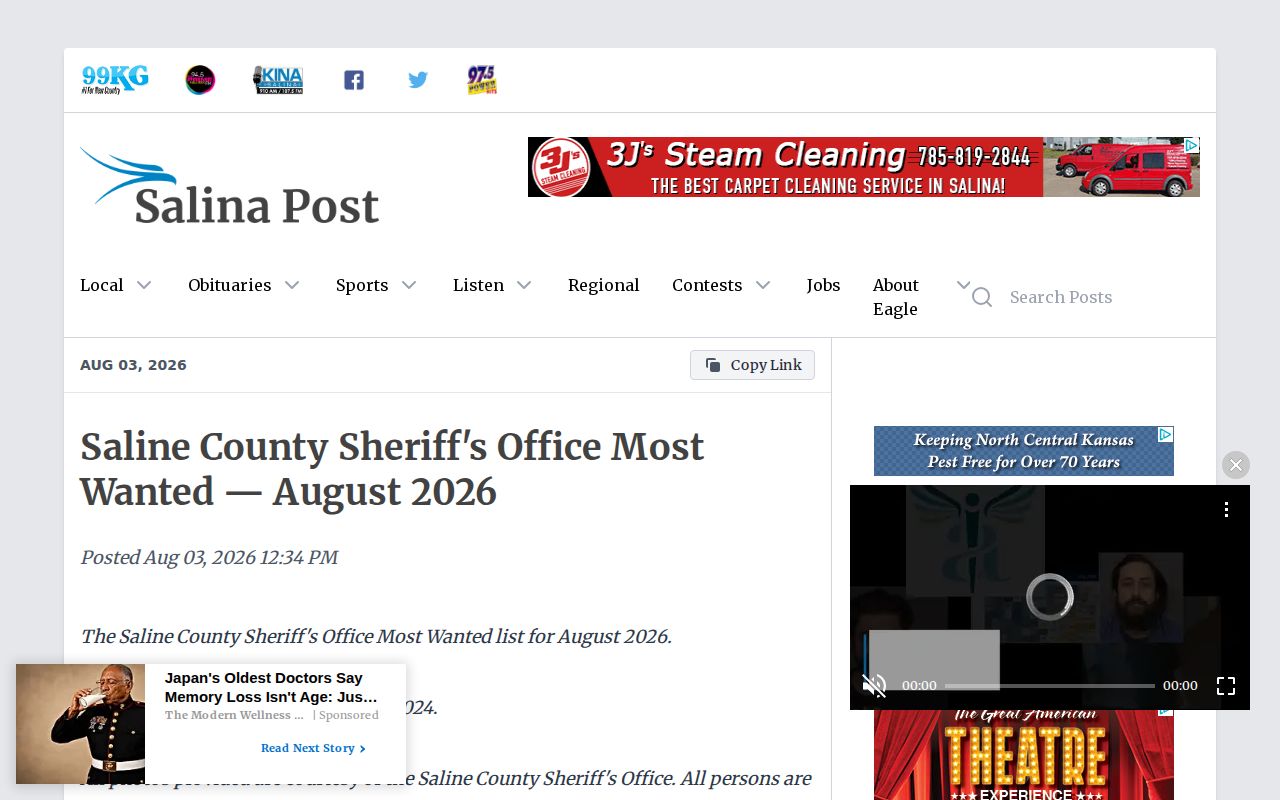
The image belongs to a dated newspaper page. Always return to the live source and then confirm current warrant or custody status with the responsible office.
Resolve a Saline Warrant
A Facebook post or a search result is a terrible roadmap for dealing with law enforcement. Start with confirmed facts instead. A lawyer can reach the right court on your behalf, walk you through the procedure, and set up whatever comes next. The court clerk may pull up a case number, a hearing date, or the paperwork path that is open to the public. The sheriff's office, meanwhile, can tell you whether its current warrant record actually matches the individual you are asking about.
Once someone is booked, the paper trail splits apart. Warrant status, the custody roster, the filed charge, and the final court outcome each live in a different record. Charges get reduced or dropped. The court's recorded disposition is the outcome that counts, so check it before assuming the old wanted listing still holds true.
Kansas law also allows certain records to be sealed or expunged. That court process restricts access to qualifying files, yet private publishers do not always update right away. If an official record changes, keep a copy of the court order and contact the agency holding the entry. A newspaper, for its part, handles corrections on its own terms.
When you call a records office, help them help you. Shared names are common. An approximate date, the agency involved, and a case or booking number will narrow things fast. If a request is denied or redacted, ask why rather than assuming nothing exists behind it. Save the response and note the date, since warrant and custody status can shift after the office answers.